Your AI coding agent is installing vulnerable packages. I built the fix.
I asked Claude Code to set up an Express API with auth. It installed 23 packages in under a minute. Scaffolded routes, middleware, database layer — clean code, well-structured, ready to ship.
Three of those packages had known critical vulnerabilities. One had a CVSS score of 9.8.
Claude didn't mention it. It didn't know.
This affects you right now
If you use Claude Code, Cursor, Copilot, or any AI coding agent — your agent is recommending and installing packages based on popularity and relevance. Not security. Not license compatibility. Not whether the package was last updated in 2021.
npm audit exists. Snyk exists. Socket exists. But these are human tools — they require a human to run them, read the output, and decide what to do. Your AI agent doesn't use any of them. It just installs and moves on.
Think about how you work with AI agents now. You ask for a feature. The agent picks libraries, installs them, writes code, and you review the output. At no point in that workflow does anyone — human or AI — check whether those dependencies are safe.
Every project you've built with an AI agent likely has unreviewed vulnerabilities in its dependency tree. The 2024 State of Open Source Security report found the average application carries 49 of them.
I built Hound because this gap shouldn't exist.
60 seconds to fix it
One command. No API keys. No accounts. No config files.
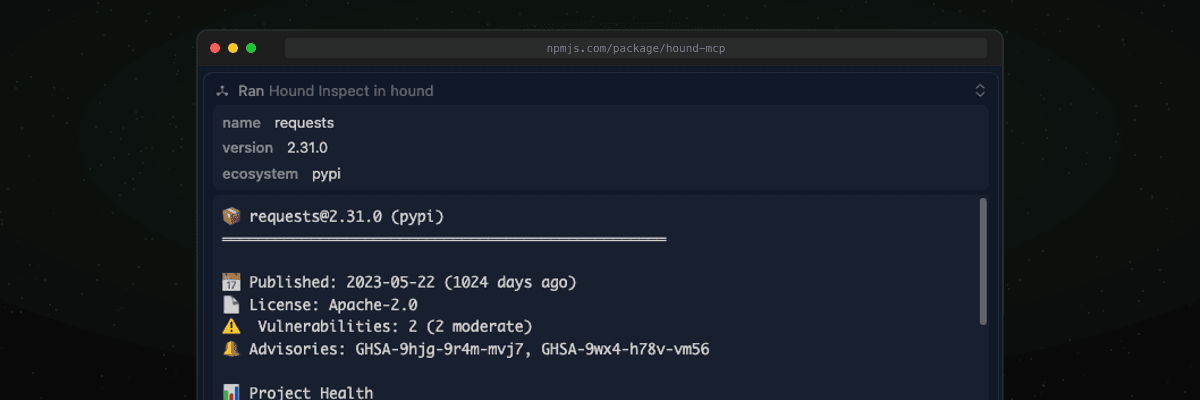
claude mcp add hound -- npx -y hound-mcpThat's it. Your AI agent now has 12 security tools it can use automatically — vulnerability scanning, license checking, typosquat detection, dependency auditing — across npm, PyPI, Go, Cargo, Maven, NuGet, and RubyGems.
You don't learn the tools. You don't configure anything. You just keep working the way you already do, and your agent starts making safer decisions.
Using Cursor, Windsurf, or Claude Desktop? Add this to your MCP config:
{
  "mcpServers": {
    "hound": {
      "command": "npx",
      "args": ["-y", "hound-mcp"]
    }
  }
}VS Code Copilot:
{
  "mcp": {
    "servers": {
      "hound": {
        "type": "stdio",
        "command": "npx",
        "args": ["-y", "hound-mcp"]
      }
    }
  }
}~/Library/Application Support/Claude/claude_desktop_config.json, Cursor at ~/.cursor/mcp.json, Windsurf at ~/.codeium/windsurf/mcp_config.json.What your agent can do now
"Audit this project"
You join a new team. Inherit a codebase. Say "audit the dependencies for security issues" and your agent reads the lockfile and runs hound_audit:
🐕 Hound Audit — package-lock.json
══════════════════════════════════════════════════
Scanned 142 packages

🔴 CRITICAL — 2 packages
──────────────────────────────
  lodash@4.17.20
    GHSA-35jh-r3h4-6jhm · Prototype pollution via zipObjectDeep
    Fix: upgrade to 4.17.21

  axios@0.21.1
    GHSA-42xw-2xvc-qx8m · Server-side request forgery
    Fix: upgrade to 0.21.2

🟠 HIGH — 1 package
──────────────────────────────
  minimist@1.2.5
    GHSA-xvch-5gv4-984h · Prototype pollution
    Fix: upgrade to 1.2.6

✅ 139 packages clean

Source: OSV.dev142 packages. Three flagged. Fix versions included. The agent upgrades them without you reading a single line of audit output. That's the entire workflow — you say "audit", it's done.
"Is this package safe to install?"
Before your agent runs npm install, it can now check first:
🚫 Pre-install check: lodash@4.17.20 (npm)
════════════════════════════════════════════════════════════
Verdict: NO-GO

🚫 Blockers
──────────────────────────────
  • 2 CRITICAL/HIGH vulnerabilities known for this version

⚠️  Warnings
──────────────────────────────
  • Package version is 3 year(s) old — may be abandoned

💡 Run hound_vulns for full vulnerability details.
💡 Run hound_upgrade to find a safe version.GO. CAUTION. NO-GO. A clear verdict your agent can act on — pick a safe version, suggest an alternative, or warn you before proceeding.
"Express or Fastify?"
Instead of guessing or Googling, your agent compares with actual security data:
⚖️  Package Comparison (npm)
══════════════════════════════════════════════════
                        express         fastify
──────────────────────────────────────────────────
Version                 4.18.2          4.26.2
Vulnerabilities         0               0
OpenSSF Scorecard       6.8/10          7.2/10
Stars                   64,128          31,204
Days since release      821             45
License                 MIT             MIT

🏆 Recommendation: fastify
More recently maintained and slightly higher security score.Not "which one is more popular" — which one is actively maintained, has better security practices, and was updated this century.
"Is this a real package or a typosquat?"
Supply chain attacks use package names that are one character off from popular libraries. hound_typosquat generates likely variants and checks if they exist in the registry — catching attacks like lodahs or axois before they land in your lockfile.
All 12 tools
You'll use three or four daily. The rest are there when you need them.
| Tool | What it does |
|---|---|
hound_audit | Scan an entire lockfile for vulnerabilities |
hound_preinstall | GO / CAUTION / NO-GO before installing |
hound_score | 0–100 health score with letter grade (A–F) |
hound_compare | Side-by-side two packages with a recommendation |
hound_upgrade | Find the minimum safe version that fixes all vulns |
hound_vulns | All known CVEs for a specific package version |
hound_inspect | Full package profile — license, vulns, scorecard, stars |
hound_license_check | Scan a lockfile against a license policy |
hound_tree | Full resolved dependency tree with transitive deps |
hound_typosquat | Detect typosquatting variants of a package name |
hound_advisories | Full advisory details by GHSA, CVE, or OSV ID |
hound_popular | Scan popular packages in an ecosystem for vulns |
Works across seven ecosystems: npm, PyPI, Go, Maven, Cargo, NuGet, and RubyGems. Same tools, same output, regardless of language.
Three built-in prompts — security_audit, package_evaluation, and pre_release_check — chain these tools into multi-step workflows your agent follows automatically.
Why zero config is non-negotiable
Most security tools: sign up → generate API key → set env vars → configure YAML → maybe install a GitHub App → restart your editor. Each step is small. Together they're enough friction that most developers never bother.
Hound uses two free, unauthenticated public APIs maintained by Google: deps.dev for package metadata and OpenSSF Scorecards, and OSV for vulnerability data. No keys, no tokens, no accounts.
This is a hard rule, not a temporary shortcut. It's in the contributing guidelines: Hound must stay zero-config and free forever. PRs that require API keys don't get merged.
The people who need security tooling most — solo developers, students, early-stage startups, open source maintainers — are the ones least likely to pay for it. Hound is built for them.
How it works under the hood
Hound is an MCP server — Model Context Protocol, an open standard by Anthropic that lets AI agents talk to external tools through a unified interface. Think USB-C for AI: one plug, any tool, any agent.
It runs as a local subprocess on your machine. When your agent calls a Hound tool, the request stays local — Hound reads your lockfile, queries the two Google APIs over HTTPS, and returns formatted results. Your code never leaves your machine.
The lockfile parser handles six formats natively — package-lock.json, yarn.lock, pnpm-lock.yaml, requirements.txt, Cargo.lock, and go.sum — with pure TypeScript regex, no external parser dependencies. The batch query to OSV checks up to 100 packages in a single API call, which is why a full audit takes seconds, not minutes.
What's coming
hound_diff— compare two lockfile snapshots to catch newly introduced risks in PRs- GitHub Action — run
hound_auditas an automated PR check, no AI agent required - Docker support — Hound in CI/CD pipelines
- Bun and Gradle parsers — more ecosystems, more coverage
Try it, break it, improve it
Hound is MIT-licensed and open for contributions. The codebase is TypeScript, tests use Vitest, CI runs across Node 18, 20, and 22.
If you've never contributed to open source before — the issues labeled good first issue are genuinely approachable. Adding lockfile parser tests, extracting duplicated constants, fixing version string inconsistencies. Real issues, real impact, good entry points.
If you've used Hound and something broke or felt wrong — open an issue. That's equally valuable.
The one rule: zero config, free forever.
GitHub · npm · Issues · Discussions